Photographs Taken by Teiji
The Earthquake BirdPhotographs Taken by Teiji are not merely records of people and places: they are private objects through which Teiji observes others, Lucy Fly tries to understand him, and the investigation into Lily Bridges’s death acquires new direction. Across the novel, the images create intimacy and suspicion while leaving crucial identities and motives unsettled.
The camera and first encounters
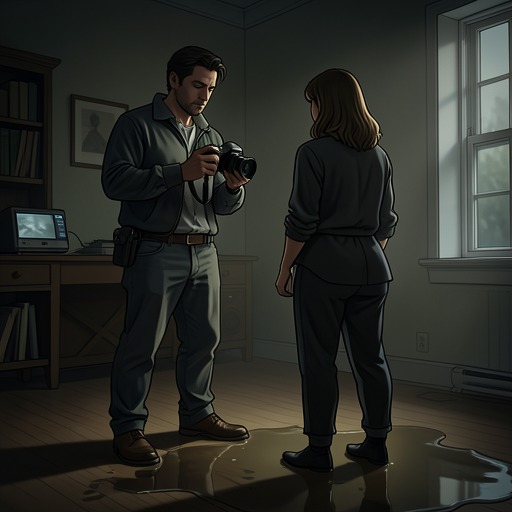
Teiji’s photographs first enter Lucy’s story as an extension of his singular way of looking. In the rain outside the Keio Plaza Hotel, Lucy sees him crouched over a puddle, photographing its reflection. The water divides the hotel’s bright windows from darkness and floating cigarette ends. Lucy steps into the puddle’s reflection; Teiji includes her feet in the frame, looks at her through the viewfinder, and takes the first photographs of her. She never sees those images. Their absence matters: the encounter feels intimate to Lucy precisely because the camera has captured something she cannot inspect or possess.
A later photograph of Lucy and Lily at Teiji’s noodle shop gives that intimacy a more complicated shape. Teiji takes it while they are eating, then gives the print to Lucy a couple of weeks afterward, carefully wrapped in newspaper. One side carries an article about rising domestic abuse; the other lists foreign exchange rates. Lucy rereads both sides for a message, although she knows no message was intended. She keeps the paper as well as the image, and takes pleasure in the fact that Teiji has given the photograph to her rather than made a copy for Lily. She understands the picture as one of herself with Lily as an adjunct, not as a portrait of two equal friends. Her jealousy is already present in how she receives and keeps it.
Lucy does not take the picture to be copied for Lily, despite knowing Lily would have liked it. Instead, she places it in a box for things she cannot bring herself to keep but cannot throw away. Looking back, she treats the moment of exposure—not anything visible in the finished image—as the beginning of trouble. The photograph shows only the two women seated at a table; its later significance comes from the act of taking it and from Lucy’s retrospective sense that a decisive shift occurred unseen.
The private archive and Sachi
Teiji’s larger collection is stored in boxes in his room, where envelopes and folders hold carefully arranged photographs. Lucy knows the room intimately but recognizes the boxes as forbidden territory. After Teiji leaves, she lets herself into his apartment with a spare key hidden in a crack beside the front door. She sets aside the childhood photographs and searches the box chronicling his life in Tokyo, looking for the years before he met her. The collection thus becomes both a record of Teiji’s past and the object of Lucy’s increasingly intrusive desire to fill the gaps in what she knows about him.
Among images of water, pavement, stations, and tunnels, Lucy finds a woman photographed through a bus window, then follows her appearance backward through the sequence. The earliest image she locates shows the woman alone on a small theater stage, wearing a soldier’s uniform and carrying a gun. Later photographs place her in other theatrical costumes and then at coffee shops, parks, a riverside, and parties. As the sequence advances, the woman appears less often as an actress; her clothes become crumpled and stained, and her expression seems increasingly sad. In the last image Lucy sees, she lies face-down on pavement with her head turned to one side. Lucy cannot tell whether her raised mouth is a grimace or a smile. On a subsequent nighttime walk through Shinjuku, Lucy connects the theater photographs with Sachi and wonders how closely Teiji’s relationships with Sachi, Lucy, and Lily followed one another. The archive supplies a visual chronology, but not a reliable account of what happened between the people in it.
Teiji returns while Lucy is still looking and tells her that the photographs are private. She is caught in the act. Lucy is sorry to have been discovered, but admits to herself that she is not sorry she looked. The episode makes the photographs more than an archive: their value to Lucy lies partly in the knowledge Teiji has withheld, while his claim to privacy marks the limit she has crossed.
Photographs as evidence
After Lily disappears, the distinction between an image and what can be proved from it becomes consequential. A few days after Lily’s disappearance, a woman’s torso and matching limbs are recovered from Tokyo Bay. Because the remains have no hands or fingerprints, the police cannot formally identify them; nevertheless, many people accept that the body is Lily’s. Lucy is also suspected after a neighbor reports seeing Lily leave Lucy’s apartment and Lucy follow carrying a bundle. The apparent certainty surrounding the body and the neighbor’s account helps turn suspicion toward Lucy, but neither settles the identity of the victim or establishes who killed her.
A new envelope arrives at the police after details about Lucy appear in national newspapers. It contains two photographs, and the police find no fingerprints on either. One shows Lily at a McDonald’s near Lucy’s home on the night of the murder, roughly two hours after Lily was seen at Lucy’s front door. A cashier recalls Lily with a Japanese man; the two seemed distressed and had difficulty communicating. Lily leaves her cheeseburger untouched but drinks her Coke. This image supplies an observed place and time that complicate the assumption that Lucy’s brief later outing, with stockings over one shoulder, was connected to Lily’s death.
The second photograph shows a woman compressed within close brown walls, her head lolling and her eyes empty. The narrative does not establish the woman’s identity from the image. Nor do the photographs prove that Teiji took them: the police do not know their photographer, though Lucy believes she does. Their force is narrower but decisive. Along with the other new evidence, they help show that Lucy did not kill Lily; they do not demonstrate that Teiji killed her. After the body of Lily herself is found in an unused shed near Lucy’s home, strangled, the earlier torso’s mistaken identification becomes plain. The images expose how quickly a plausible account can harden into accepted fact, while also leaving the central question of responsibility unresolved.
What the images can and cannot settle
Lucy reads Teiji’s photographs as clues to his attachments and habits, but her interpretations repeatedly exceed what the pictures establish. The woman in the archive becomes part of Lucy’s reconstruction of Teiji’s past; the image of Lily with a Japanese man prompts questions about their meeting and conversation; the second police photograph encourages Lucy to suspect Teiji. Yet no photograph supplies a complete explanation. The camera fixes a visible fragment, while the circumstances that would make it conclusive remain outside the frame.
That gap gives the photographs their double role. They are objects of intimacy and possession in Lucy’s relationship with Teiji, private material she takes without permission, and forensic traces that revise the police’s understanding of Lily’s final night. A print can be treasured, withheld, or sent anonymously; its meaning changes with who sees it and what they already suspect. The collection makes absence tangible—missing years, unseen pictures, a woman whose final circumstances cannot be read with certainty—without converting observation into proof. In the end, Teiji’s photographs help release Lucy while preserving uncertainty about Teiji and the murder.